Most people picture entrepreneurs as innovators.
They imagine someone sketching ideas on a paper, pitching investors, or launching the next big thing from a garage.
Yet after years in franchising, entrepreneurship, and business consulting, I’ve noticed something different.
Many successful business owners did not begin as entrepreneurs at all.
They began as firefighters.
Electricians.
HVAC technicians.
Plumbers.
Paramedics.
People whose careers required them to solve problems under pressure, follow systems, and deliver results consistently.
In other words, they were already practicing many of the skills ownership requires long before they ever considered buying a business.
The Myth That Keeps Good People From Exploring Ownership
One of the biggest misconceptions about business ownership is the belief that it belongs to a certain personality type.
The natural salesperson.
The person who has always dreamed of running a company.
However, that stereotype discourages thousands of highly capable people.
I’ve seen it firsthand. A firefighter who has led emergency scenes involving dozens of people will tell me she’s not sure she has what it takes to own a business.
An electrician who has managed crews, budgets, timelines, and customer expectations for years will tell me he doesn’t have enough business experience.
Meanwhile, those same people demonstrate ownership potential every day.
The issue is merely a lack of recognition of skills.
Tradespeople Often Make Strong Business Owners
At its core, business ownership is not one skill. It is a collection of skills.
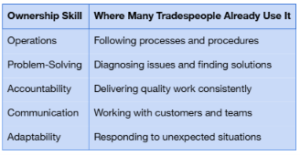
Notice what is missing.
“Being born an entrepreneur.”
Franchise systems are not inherent but are built on execution.
And execution is exactly what professionals do best.
A franchisor would often rather work with someone who follows proven systems than someone who constantly tries to reinvent them.
Showing up every day and being effective, that same energy will transfer well in business.
What I Learned From My Own Experience
Before becoming a franchise consultant, I owned a healthy vending machine business.
From the outside, it looked similar to a franchise.
I purchased machines. Negotiated locations. Handled stocking.
Managed logistics. Solved problems. Found growth opportunities.
And I grew that business by more than 700%.
But there was one major difference. I was largely on my own.
There was no support team helping me improve operations.
No structured training. No established system designed to help me scale. No one invested in whether I succeeded after the initial sale.
That experience taught me something important: the right business is not simply one that grows. It is one that gives you the support and systems to grow intelligently.
That realization eventually led me into franchise ownership and franchise consulting.
Myth vs Reality
What I usually remind people is this. Most ownership struggles do not come from lack of ability. They come from stepping into a role where the structure is no longer provided. Let’s clear up a few common misconceptions.
Myth #1:
“I don’t have a business background.”
Reality:
Many successful owners start with operational backgrounds rather than business degrees.
Myth #2:
“I’d have to learn everything from scratch.”
Reality:
Franchise systems provide training, onboarding, marketing support, operational guidance, and ongoing coaching.
Myth #3:
“Business ownership is only for natural entrepreneurs.”
Reality:
Many strong owners are disciplined operators who excel at execution, consistency, and leadership.
Think about your profession.
Would you rather walk into a building with no blueprint?
Would you rather diagnose a complex problem with no process?
Would you rather manage a team without procedures?
Of course not.
Systems create consistency. Consistency creates predictability. Predictability often creates growth.
One reason franchising appeals to many skilled professionals is that it provides structure.
And structure can dramatically reduce unnecessary trial and error.
Some people thrive inside established systems.
Others want to learn how to operate one.
Additionally, when people hear “franchise,” they often think about burgers and drive-thrus.
In reality, franchise ownership spans dozens of industries.
In fact, there are more than 200 franchise concepts across industries such as home services, property management, senior care, pet care, vending, and health and wellness. The challenge is not availability. The challenge is alignment.
And alignment is something that deserves conversation.
Pitfalls to Avoid
If you are exploring ownership, avoid these common traps:
- Assuming every franchise operates the same way.
- Choosing a business solely because of brand recognition.
- Underestimating the importance of support systems.
- Ignoring lifestyle fit.
- Making decisions without understanding the owner’s actual role.
The question isn’t whether you can work hard.
You’ve already proven that.
The question is whether your effort is building something that you ultimately own.
Many firefighters, tradespeople, and first responders spend decades creating value.
The opportunity worth exploring is whether some of that value could eventually flow into an asset of your own.
That does not mean everyone should buy a business.
Far from it.
Sometimes the right answer is “not yet.”
Sometimes it’s “not this industry.”
Sometimes it’s “not this model.”
And sometimes it becomes a path that creates more flexibility, autonomy, cash flow, and long-term opportunity than someone initially imagined.
That’s why evaluation matters.
If you are trying to understand whether your background fits ownership in a realistic way, it may be helpful to talk through it with someone who has seen both successful transitions and avoidable mistakes.
If you’re curious about ownership, the goal is to help you understand what is realistic.
What fits your strengths. What aligns with your family goals.
And just as importantly, when you should not buy.
Because one conversation can change the direction of the next decade. I only suggest conversations when there’s real alignment to explore.
