Spend enough time around successful investors and you’ll notice something interesting.
Early on, most discussions revolve around finding the next property. Better cap rates. Better financing terms. Better locations. Better appreciation potential.
Clearly enough, real estate has created enormous wealth for generations, and for many investors it remains the foundation of a strong portfolio.
But after a while, a different question begins to surface.
“How exposed am I if all my income sources depend on the same asset class?”
That question often marks the beginning of a much larger wealth-building conversation.
Diversification Is Not Just About Investments
Most investors understand diversification intuitively.
Few financial advisors would recommend putting every dollar into a single stock, a single sector, or a single market.
Yet many portfolios are more concentrated than they appear.
Owning five rental properties may feel diversified. But if all five properties depend on the same economic forces—interest rates, housing demand, local market conditions, insurance costs, and tenant behavior—you may still be relying on a single engine to drive your wealth.
That doesn’t make real estate bad.
It simply means true diversification is broader and often involves different types of assets producing income in different ways.
Real Estate and Business Ownership Have More in Common Than You Think
Many investors initially view business ownership as something completely different from investing.
In reality, the underlying principles are surprisingly familiar.
Both require due diligence.
Both involve risk management.
Both reward operational improvements.
Both can generate ongoing cash flow while building long-term asset value.
The mechanics differ, but the investment mindset remains remarkably similar.
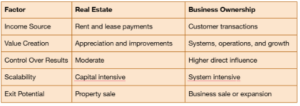
The reason for exploring businesses is simple:
You want another engine.
Here is a fun fact that surprises many people:
Most investors spend years learning how to evaluate properties, yet never learn how to evaluate a business.
That creates an interesting blind spot.
A seasoned investor can often analyze a rental property in minutes.
But when presented with a business opportunity, even sophisticated investors sometimes struggle to determine what questions matter most.
Part of the challenge is that “business ownership” is not a category.
It’s an entire ecosystem.
- A senior care business behaves differently than a home services company.
- A pet-care brand operates differently than a property management business.
- A health-and-wellness concept has different economics than a vending operation.
Grouping them together would be like comparing apartment buildings, self-storage facilities, farmland, and retail centers as if they were identical investments.
The Comparison Spiral
When an investor starts researching opportunities.
One concept leads to another.
Then another.
Soon there are twenty browser tabs open.
Every business looks promising.
Every opportunity sounds compelling.
It is overloaded.
The problem is the absence of a framework.
Without one, opportunities become difficult to compare because they solve different problems and require different owner roles.
The smartest investors I know don’t begin by evaluating businesses.
They begin by evaluating themselves.
Questions Experienced Investors Ask First
Before looking at brands, industries, or projections, strong investors often clarify a few fundamentals:
Am I looking for active income, passive income, or something in between?
How much time am I realistically willing to commit?
What am I trying to accomplish that my current portfolio does not provide?
One reason I became fascinated with franchising is that I experienced both sides. I owned a business that depended heavily on my involvement. It taught me that revenue is only one metric. The quality of the systems behind that revenue matters just as much.
When I Tell People Not to Buy
As a franchise consultant, there are times when I advise someone not to move forward.
If someone is trying to escape a bad situation rather than move toward a good one, I usually suggest slowing down.
If someone expects a business to solve problems they haven’t clearly defined, we need a longer conversation.
If the investment only works under perfect circumstances, it probably isn’t a strong investment.
And if someone cannot clearly explain why a particular business fits their goals, timeline, and lifestyle, they likely need more evaluation before making a decision.
Good decisions rarely come from urgency.
They come from understanding.
A Different Way to Think About Wealth
The most sophisticated investors eventually focus on income sources.
They understand that diversification isn’t simply owning more things.
It’s creating multiple ways for value to enter their lives.
And for some people, business ownership becomes another piece of the puzzle.
Not because it’s exciting.
Because it serves a purpose.
Final Thought
One lesson I’ve learned from owning businesses, operating franchises, and helping others evaluate opportunities is that clarity usually arrives when options become narrower, not wider.
The goal isn’t to chase every opportunity.
The goal is to understand which opportunities actually deserve your attention.
If you’ve started wondering whether business ownership could complement your investment strategy, let’s have a conversation focused on education, fit, and realistic expectations.
When it’s the right fit, these conversations are usually very clarifying. Book your free discovery conversation with me here.
In 30 minutes, you’ll learn that the best investment decisions are rarely made in excitement.
They’re made in clarity.
