At 6:10 a.m., someone is already answering emails before breakfast.
By 8:30 a.m., another professional is mentally rehearsing tomorrow’s meeting while barely noticing the morning in front of them.
At 9:17 p.m., a parent quietly reopens a laptop after dinner because “just one more thing” turned into another hour.
None of these people are failing. Most are actually considered successful.
Good salaries. Stable careers. Strong resumes. Respectable lives built through years of discipline and consistency.
Yet many professionals eventually notice something strange about modern success:
The higher they climb, the less their time seems to belong to them.
Because increasingly, the modern luxury is not money alone. It is control over your time. Success feels different when your calendar belongs to you.

The Hidden Cost of Climbing the Ladder
Most careers reward reliability. The more valuable you become, the more people depend on your availability.
At first, that dependence feels validating. It signals trust, competence, and growth. Over time, however, it can begin to feel consuming.
The hidden cost often appears gradually:
- Work follows you home.
- Flexibility becomes harder despite seniority.
- Family moments compete with professional obligations.
- Vacations remain partially connected to work.
None of this necessarily means someone dislikes their career.
That is what makes the conversation complicated.
Many professionals genuinely enjoy what they do.
They simply begin questioning whether the structure that helped them succeed still supports the life they want long-term.
Re-Evaluating “Safe”
For years, entrepreneurship was framed as the risky path while employment represented stability.
But recent economic shifts have complicated that assumption. Layoffs happen inside major corporations. Leadership changes reshape entire departments. Burnout accumulates quietly over time.
And many professionals realize their financial future still depends heavily on decisions made far above them.
As a result, more people are rethinking what risk actually means.
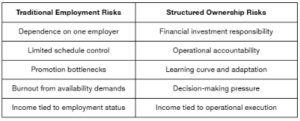
Neither side is risk-free. That is the point.
The question is no longer:
“How do I avoid risk entirely?”
A better question is:
“Which form of risk creates the life I actually want?”
Of course, ownership is not for everyone.
And thoughtful professionals should be skeptical of anyone who pretends otherwise.
Business ownership still requires:
- Emotional resilience
- Operational learning
- Long-term thinking
There are no shortcuts around that reality.
This is also why many professionals hesitate.
They are responsible people with mortgages, families, careers, and legitimate concerns about making major transitions recklessly.
That hesitation is healthy.
It means someone is evaluating carefully rather than reacting impulsively.
For that reason, ownership opportunities should reduce unnecessary uncertainty by providing:
- Established systems
- Operational support
- Training and guidance
- Repeatable business processes
There is a meaningful difference between blind entrepreneurship and structured ownership.
For many professionals, that distinction changes the conversation from:
“This feels reckless.”
to
“This feels worth evaluating.”
One of the healthiest ways to explore ownership is through practical evaluation rather than emotional urgency.
A few quality-of-life questions can help:
- Does my current structure support the life I want long-term?
- What am I optimizing for beyond compensation?
- What would I regret not exploring five years from now?
Conclusion
The most important shift begins when someone pauses long enough to ask whether their current structure still fits the future they want.
And sometimes, the first step toward greater clarity is simply exploring options with someone who understands both the opportunities and the realities.
If this conversation made you think differently about how your time is spent, and who ultimately controls it, you may book a free discovery call with me here. Sometimes the most valuable insights come from seeing how other professionals are thinking about the same questions.
