Imagine if someone told you they invested nearly all of their savings into a single stock.
You would probably raise an eyebrow.
Financial advisors call that concentration risk. If one asset struggles, everything feels the impact.
Yet millions of households unknowingly accept a similar setup in another part of their financial lives.
Not in their investments but in their income.
For many professionals, one employer provides most or all of the household’s income. As long as the paycheck arrives, the arrangement feels stable. Because it feels familiar, it rarely gets labeled as a risk.
The Income Basket Test
A simple way to see the structure clearly is to think in baskets.
If your household income were eggs, how many baskets are they sitting in right now?
For many professionals, the honest answer is one.
One employer.
One payroll cycle.
One decision point outside their control.
And while careers offer stability, benefits, and growth, that structure still exists underneath everything else.
It only becomes visible when something shifts, restructuring, leadership changes, industry slowdown, or decisions made far above your desk that still land directly in your life.
Most of the time, those shifts don’t announce themselves early.
They arrive after the direction has already changed.
A Simple Map of Income Structure
Here is a straightforward way I often help people visualize it:
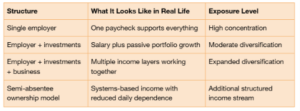
Business ownership is sometimes explored not as a replacement, but as an additional layer of financial structure. However, for most, it is an untreaded path.
And humans tend to confuse unfamiliarity with danger. That does not mean ownership is safer than employment. It simply means the risks are different.
The challenge is learning how to evaluate those risks intelligently.
Not All Businesses Work the Same Way
One common misconception is that business ownership means opening a restaurant or fast-food location.
In reality, businesses come in many forms, each with different demands.
Some examples include:
- Home services such as cleaning, painting, or restoration
- Senior care and in-home support services
- Children’s education and tutoring programs
- Pet care and grooming services
- Property management businesses
- Marketing and staffing companies
- Vending and unattended retail operations
- Fitness, wellness, and recovery centers
The important lesson is that every model creates a different lifestyle.
Some require daily hands-on involvement.
Others operate with managers and established systems.
Some depend heavily on sales.
Others rely on recurring customers.
The business category matters, but the operating structure often matters more.
The Risk Most People Don’t Price In
When evaluating business opportunities, most people naturally focus on financials first.
Cost of entry.
Potential return.
Break-even timeline.
But there is another layer that often gets overlooked.
How long will it take me to learn this?
The learning curve.
Every business introduces a new environment:
- You learn operations
- You learn hiring
- You learn customer behavior
- You learn problem-solving in an entirely new environment under pressure
Even strong, well-supported models still require adaptation and learning.
This is where many ownership conversations become unrealistic. People imagine profits without accounting for the education required to produce them.
The truth is simple:
Every business owner pays tuition.
Sometimes with money. Sometimes with time.
Usually with both.
Smart Evaluation Beats Excitement
Experienced operators rarely get excited by flashy projections.
They slow the conversation down and focus on structure.
Instead, they ask practical questions:
- What skills must be learned?
- How long does the learning curve typically last?
- What systems already exist before I step in?
- What level of support exists when I am still learning?
Ownership is not a magic solution. It introduces new responsibilities, new risks, and new learning curves.
But evaluating those risks thoughtfully can teach something valuable:
Financial resilience is often built not by eliminating risk, but by understanding which risks are worth learning to manage.
If you are currently evaluating whether business ownership fits into your financial picture or long-term career planning, it can help to step outside the noise and look at structure first, not excitement.
I am here to help you reach that clarity, whether you’re evaluating a franchise, scaling your brand, or preparing for your next big move.
If you’d like to explore your options in a grounded and practical way, you can schedule a 30-minute conversation here.
