Most professionals spend years learning how to perform effectively inside systems.
Hit targets. Stay dependable. Build stability.
Repetitions until the compensation improves. The resume strengthens. Life appears increasingly secure from the outside.
But eventually, many professionals encounter a quieter realization:
They built a successful career yet still do not fully control how their life operates.
At some point, many people stop asking:
“How can I keep advancing?”
And begin asking:
“What am I actually building this for?”
The answer is increasingly about identity.
The Four Identity Shifts That Typically Precede Ownership
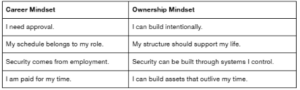
This shift tends to unfold gradually, often after years of operating successfully inside demanding environments where performance is rewarded but autonomy remains fixed.
When Stability Starts to Feel Like Constraint
Many professionals operate within what is commonly described as the “golden handcuffs.”
A situation where:
- income is strong
- benefits are reliable
- career trajectory is stable
- external validation is present
Yet internally, something begins to shift. Over time, the structure introduces constraints such as constant availability expectations, dependence on organizational decisions, as well as priorities shaped more by obligation than choice.
The complexity is that none of this typically looks like a problem from the outside. Which is why many professionals struggle to articulate the discomfort.
“How can I feel restricted when everything looks successful?”
By definition, the professional may be performing well, earning well, and advancing steadily. However, over time, the trade-offs become more noticeable. Greater compensation often comes with greater responsibility.
As a result, leaving becomes difficult not because the individual lacks alternatives, but because the cost of walking away from what has been built feels significant.
Golden handcuffs are not about being trapped by failure. They are about feeling constrained by a version of success that no longer fully aligns with the life a person wants to build.

The Identity Lag Is the Issue
A common misconception about ownership is that it requires a fundamentally different type of person.
In reality, many professionals already operate with ownership-level capability:
- Managing pressure and uncertainty
- Leading teams and making decisions
- Solving operational problems
The issue is rarely competence. It is identity alignment.
Many professionals have spent so long operating as employees that they do not recognize the extent to which they already think like owners.
This is why the transition is often not technical but rather what is inside the mind.
Over time, professionals begin valuing energy management, family presence, sustainability, and control over time itself. This is where the conversation changes. Not because ambition decreases. But because ambition evolves
One of the most misunderstood aspects of business ownership is the assumption that it is primarily a financial pursuit.
In practice, many professionals are motivated by structure rather than speculation.
They are asking questions such as:
- How dependent is the business on constant involvement?
- Does this create flexibility over time or reduce it?
- Can this integrate with the life I want long-term?
They are structural questions about how life will be organized. The strongest ownership decisions are driven by clarity about how systems function in real life.
Traditional entrepreneurship is often perceived as high-risk because it requires building everything from zero. This is where franchising becomes a bridge.
Franchising introduces a different model:
- Established operational systems
- Structured training and support
- Existing brand frameworks
- Proven business processes
- Reduced trial-and-error in early stages
The goal is not to remove work completely but to reduce unnecessary ambiguity while building something independently. For professionals who are used to structure, accountability, and performance systems, this can feel more practical and familiar.
Conclusion
Most professionals do not begin with a desire to leave their careers.
The question emerges more subtly:
“Do I want the next decade to look exactly like the last one?”
Business ownership is rarely just a financial transition.
For many professionals, it becomes an identity shift:
- From operating within systems to designing them
- From reacting to structure to creating it
- From fitting life around work to building work around life more intentionally
That is why my introductory conversations are structured to be practical, grounded, and focused on alignment rather than urgency.
Sometimes the most important change is not in what you do next.
You deserve honest guidance before making a life-changing decision. It is how you begin to see what is possible next.
This conversation may continue in a more practical way around lifestyle fit, flexibility, and whether ownership realistically aligns with your current stage of life.
If you have been reflecting on whether your career still matches the kind of life you want long term, I would be happy to have a grounded introductory call here, focused on clarity, lifestyle goals, and whether business ownership could realistically support the direction you want to go.
